

Trump Addresses Immigration and CDL Reform in State of the Union
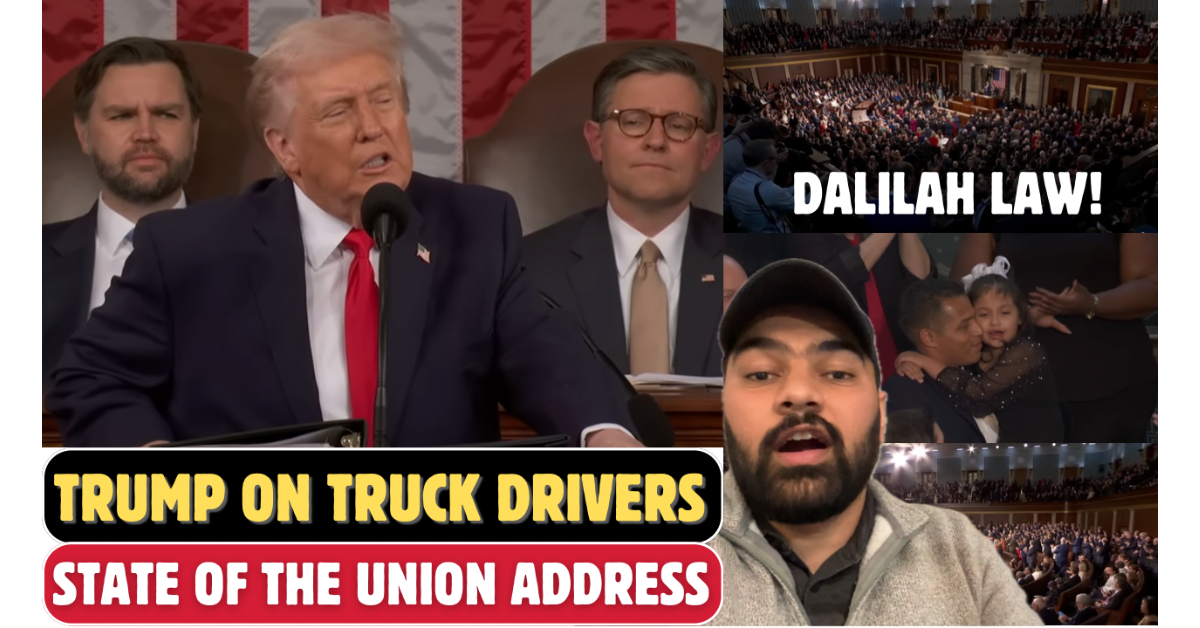
During his recent State of the Union Address, Donald Trump placed heavy emphasis on immigration reform — particularly targeting commercial driver’s licenses (CDLs) issued to undocumented immigrants.
One of the most talked-about moments from the speech was his call for Congress to pass what he referred to as the “Dalilah Law.” The proposal would prohibit U.S. states from issuing commercial driver’s licenses to undocumented immigrants.
According to Trump, the primary duty of the American government is clear:
“The first duty of the American government is to protect American citizens — not illegal immigrants.”
This statement quickly gained traction online and became one of the most viral lines from the address.

What Is the “Dalilah Law”?
The proposed legislation is named after Dalilah Coleman, a young girl who was severely injured in a 2024 crash involving an 18-wheel tractor-trailer.
Trump stated during the speech that the truck driver involved in the accident was an undocumented immigrant who had obtained a CDL in California. He blamed what he described as “open border policies” under Joe Biden and certain state-level decisions for allowing the situation to occur.
Under the proposed Dalilah Law:
-
States would be federally restricted from issuing CDLs to undocumented immigrants.
-
Commercial driving eligibility would require lawful immigration status.
-
The federal government would take a stricter oversight role in CDL issuance policies.
Concerns About Road Safety and Language Barriers
Trump also argued that some undocumented drivers may not:
-
Speak English fluently
-
Read basic road signs
-
Understand speed limits or safety warnings
He framed this as a public safety issue, suggesting stricter CDL rules are necessary to reduce accidents and protect American families.
Supporters of the proposal argue that commercial trucking requires high levels of safety awareness and regulatory compliance, and that federal standards should be uniform nationwide.
Political Tensions and Government Funding Debate
In addition to immigration, Trump criticized the Democratic Party over a partial government shutdown and claimed funding for the United States Department of Homeland Security had been restricted.
He demanded:
-
Immediate restoration of border security funding
-
Stronger immigration enforcement
-
Tougher penalties for criminal offenders in the country illegally
During the address, members of the Republican Party stood in support, while Democratic lawmakers largely remained seated — highlighting the deep political divide on immigration policy.
Impact on Immigrant Truck Drivers
If passed, the Dalilah Law could significantly impact:
-
Undocumented immigrants currently working in trucking
-
Individuals hoping to enter the U.S. commercial driving industry
-
States with more flexible licensing policies
For many immigrants, trucking has been seen as a path to financial stability in America. A federal restriction would dramatically change that opportunity.
What Happens Next?
At this stage, the Dalilah Law is a proposed piece of legislation and would need congressional approval to become law. With midterm elections approaching, immigration policy is once again shaping up to be a defining political issue.
Whether the bill advances or stalls will depend heavily on congressional negotiations and the broader political climate.
Final Thoughts
Trump’s speech made it clear that immigration enforcement — especially concerning commercial driver licensing — will remain a central theme in upcoming political debates.
The conversation now shifts to Congress and to American voters, who will ultimately influence how immigration policy evolves in the coming years.